
Talk To A Human 24/7
800-487-3808
800-487-3808

Finding the best insole is crucial to maintaining foot health and treating some of the most common foot conditions. Insoles can be the perfect option for everything from plantar fasciitis, to heel spurs, high arches, and more. However, it's not always easy to find the right fit — especially when considering the range of variables like material, arch type, length, and footbed. Check out our selection below and learn what features are available in each style. We will help you find the insole specifically tailored to your sole.


To make sure you're choosing the right brace to suit your needs, we'll break down all the crucial factor
Sizing options vary based on the insole type you select. Each pair of insoles includes a detailed sizing chart and measurements to help you find the right fit. Most insoles (excluding our carbon fiber insoles) are also trimmable, allowing for an even more precise fit.
Our selection of insoles are typically available in both full-length and ¾ length. Depending on preference, customers usually prefer one style or the other.
Full-length insoles offer support to the forefoot, as well as the arch and heel. This makes them ideal for those who do plenty of walking or running, or suffer from chronic sores on the front of their foot. Just replace your shoe's factory insoles and enjoy all their benefits.
This option is ideal if you wear slim or short shoes, or plan on transferring between different pairs on a regular basis. Their compact size makes them easier to handle and fit in smaller shoes. Put them right on top of your existing insoles for a perfect fit.
Insoles are made from various materials, each designed to serve different purposes. Choosing the right material ensures that your next pair meets your specific comfort and support needs.
EVA foam is a lightweight, flexible, and firm material, making it an excellent choice for insoles. Its supportive structure is especially popular for athletic shoes and provides relief for individuals with foot conditions like plantar fasciitis. The balance of flexibility and firmness in EVA foam helps absorb impact while maintaining arch support, enhancing comfort during physical activity and daily wear.
PU foam is known for its softness, durability, and excellent shock absorption. Compared to EVA foam, PU foam offers greater cushioning, which adds a bit more weight but significantly enhances comfort. Its high resilience means it resists compression and maintains its shape over time, making it ideal for long-lasting support. If comfort is your top priority, PU foam insoles are an excellent choice for all-day wear. See our Memory Foam Insoles and Heavy Duty Gel Insoles.
Gel is an excellent material for insoles due to its superior cushioning and shock absorption, making it ideal for relieving pressure points in the heel and ball of the foot. Gel insoles conform closely to the foot's shape, helping to reduce discomfort and fatigue — especially for those on their feet all day. While slightly heavier than EVA or PU foam insoles, gel provides targeted comfort where it's needed most. Note that gel insoles typically offer less structural support, as their primary function is to alleviate pressure rather than provide firm arch support.
Our carbon fiber insoles are crafted from 3K twill carbon fiber, delivering a strong and lightweight footbed. The unique "twill" weave offers the ideal blend of flexibility and resilience, allowing the insoles to move with your foot while providing reliable support. This material's lightweight structure minimizes bulk, while its inherent rigidity ensures the stability and support needed for active use and high-impact activities. Check out our Carbon Fiber Insoles →
Knowing your arch type is an important factor when picking the right insole. To learn whether you have high, low, or neutral arches, try the footprint test.
1. Wet the bottom of your foot.
2. Make an imprint on a piece of cardboard.
3. Identify your arch. If the middle section of your foot is completely filled in, you may have low arches. If it is missing completely, you may have high arches. It is common to fall somewhere in the middle.

Neutral arches are the most biomechanically efficient, effectively absorbing shock and resisting over-pronation. Around 60% of people have neutral arches. Keep in mind that those with neutral arches can still suffer from common foot conditions like heel pain and metatarsalgia. If you have neutral arches, look for an insole that provides a balance of arch support and cushioning for the heel and ball of the foot.
Those with low or fallen arches will have feet that hug the floor, with little to no arch definition in the midsole. Low arches are more flexible, making them susceptible to rolling, overpronation, and plantar fasciitis. If you have fallen arches, make sure to find an orthotic with plenty of medial rearfoot support — our EVA foam insoles are a good bet.
High arches are characterized as being very rigid, with a pronounced arch that rises high off the ground. This leads to excessive pressure being placed on the heel and ball of the foot, causing pain. The perfect orthotics will fill in your arch cavity, taking the pressure off other parts of the foot. Give our full-length Plantar Plus insoles a try for reinforced arch support.
Our insoles come in a variety of different footbed options, offering different levels of cushion and rigidity.
A rigid footbed offers firm, stable support with minimal flexibility, designed to maintain proper foot alignment and reduce strain. Its solid structure helps limit unnecessary foot movement, enhancing control and stability — especially during high-impact activities. Our Carbon Fiber Insoles are an ideal choice for those seeking a rigid footbed that maintains its supportive qualities.
A semi-rigid footbed blends the structural support of a rigid insole with the flexibility of a softer one, creating a comfortable and adaptive foundation. With a slight give, semi-rigid footbeds naturally follow foot movement, maintaining alignment and arch support while enhancing comfort and reducing fatigue. This type of insole provides moderate support with just the right amount of cushioning, making it excellent for daily wear and athletic activities.
Cushioned footbeds provide mild support, with the primary benefits being exceptional comfort and shock absorption. Made from soft materials like gel or memory foam, these insoles are designed to cradle the foot, reducing stress on the feet, joints, and lower back. Ideal for those seeking relief from foot fatigue or general discomfort — especially beneficial for individuals who spend long hours on their feet.
Still not sure which brace is perfect for you? Here's what we recommend based on common conditions our customers face.

The Plantar Plus Full-Length offers reinforced arch support and a deep heel cup to ensure relief while stabilizing your foot. Its versatile design works with all types of shoes while staying durable after extended wear.
Our Plantar Plus Full-Length insoles are perfectly suited to support your arches with soft material that absorbs the shock of each footstep. They prioritize heel support to ensure comprehensive foot comfort, making long walks more comfortable.

Our Memory Foam Insoles relieve pressure off the balls and heels of your feet with cushioned memory foam footbeds. They fit comfortably into a variety of dress and athletic shoes. For more arch support, consider the Full-Length Plantar Series.
Our Plantar Plus Full-Length insoles feature shock absorbing gel and a non-slip material to ensure each step is supported exactly where you need it, without shifting inside your shoe over the course of the day.
We recommend the Plantar Plus Full-Length for lightweight support you can count on. Their targeted relief and pronounced arch support can make the difference — and they fit with all styles of shoe.
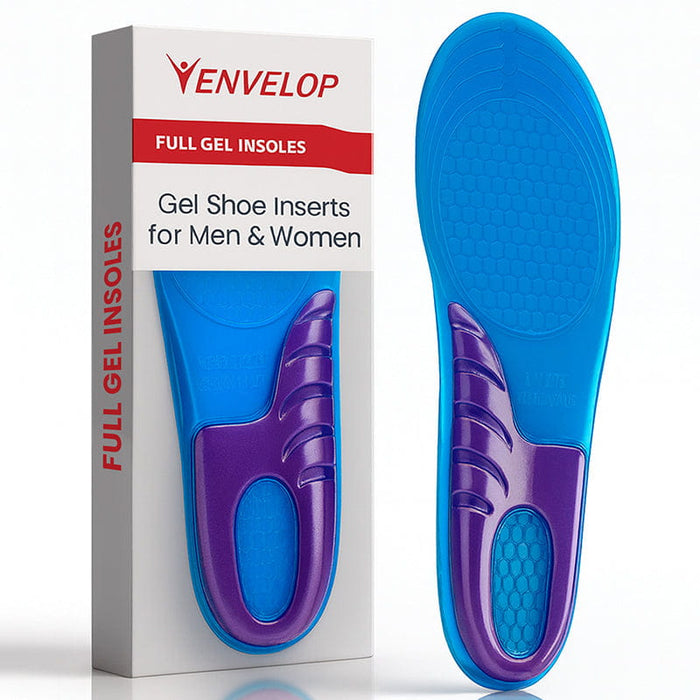
Our Full-Length Gel Insoles are a great choice for cushioned and cooling support that lasts throughout the day, with a honeycomb design made for absorbing the shock of each step.

Envelop's Full-Length Foam Insoles feature reinforced plastic and soft padding to keep pain and inflammation at bay. EVA padding retains shape over extended use, and antibacterial material can be machine washed to keep them fresh.

For conditions such as Hallux Rigidus, Turf Toe, Arthritis, Morton's Toe, and foot fractures, we recommend our Carbon Fiber Insoles. Rigid yet flexible, extremely lightweight, and provide adequate support to the entire foot without restricting natural movement.

Our Arch Support Gel Insoles are the perfect choice for diabetic feet, with soft gel padding to protect against sores and relieve the stress on pressure points. They can be easily slipped in and out of shoes, so you won't need multiple insoles for different footwear.
Our Plantar Plus Full-Length insole keeps your plantar fascia ligament fully supported without flattening over time. It features breathable material to keep your feet cool and sweat-free, no matter what kind of shoes you wear them with.

Our Heavy Duty Gel Insoles provide excellent shock absorption to reduce the impact on the spine when walking or standing all day. The gel and foam cushioning distributes pressure evenly, lessening the strain on feet, ankles, and knees that can contribute to lower back stress.
Our Plantar Plus Full-Length keeps your soles padded without flattening for months. Lightweight, it won't slow down your stride, and stays contoured to your arch and heel to prevent rolled ankles and other injuries.
Envelop's Full-Length Gel Insoles offer a lightweight design that can be trimmed to different boot sizes and relieve pressure on the ball of the foot, arch, and heel simultaneously. They're also washable, so you can keep them fresh day in and day out.

Our ¾ Length Insoles offer a slim design with adequate support that covers the heel, forefoot, and arch — able to treat a range of conditions from plantar fasciitis, to flat feet, or chronic heel pain without adding bulk to lightweight footwear.
The best insoles for standing on concrete or hard surfaces tend to provide a good balance of both cushion and arch support. We recommend the Plantar Plus Full-Length Orthotics, especially if you have problems with flat feet or weak arches.
The most comfortable insoles are typically constructed of gel. While everyone has different preferences, insoles with less of an arch tend to provide more cushion and comfort rather than arch support. We recommend the Full-Length Gel Insoles by Envelop. If you need more arch support but are still focused on comfort, go for the Full-Length Gel Insoles by Vive.
With normal wear and tear, insoles last six to nine months. For those who spend the majority of time on their feet, you will need to replace your insoles more frequently — around every three to six months of use.
Full-length orthotics and insoles can be worn on top of an existing shoe insole, but if shoes become too tight and uncomfortable we recommend removing the original shoe insole. ¾ insoles or other inserts are typically always worn with existing shoe insoles.
To clean your insoles, use warm water and mild detergent to wipe clean then lightly rinse — avoid soaking the insoles. To reduce odor, try using baking soda, dryer sheets, or shoe spray to keep them fresh and kill bacteria.
To trim your full-length insoles, remove the original shoe insole and use it as a sizing guide. Place the old insole on top of your new one and mark the correct size, then trim along the line.
If you have additional questions or comments on our foot support products, make sure to contact our product specialists today.
Give them a call from 8:30 am and 9 pm EST daily at 1-800-487-3808 or email at service@vivehealth.com.
Leave a comment